Showing posts with label crisis. Show all posts

Is Your Company Failing?

COVID shutdowns caused a lot of small businesses to fold during and after, even though a few entrepreneurs seemed to flourish (especially those that provided delivery services) through it.  Bigger businesses upgraded their websites to increase online sales and went to Zoom meetings (and contine to do so for travel cost savings) to keep things going.  

Post Short URL = https://tinyurl.com/5y66azyj 

Although people are supposed to be back-at-work now, there is still a crisis in the world of business as inflation rises, regulations increase, and the economy has not yet recovered.  Large and small companies continue going under for various reasons.   

Wondering how to tell if the company you work for or the business you own is about to go out-of-business? 

Check out these articles for employees:

Check out these articles for owners :

Who Controls American Business, Media, or Government?

Do you ever wonder who really controls American business, media, or government?  For business: you might say it is American entrepreneurs starting new enterprises, or you may think of those running franchise opportunities in America and abroad, or you may say the rich citizens who already own big successful companies.  You may even look at Wall Street to see what is currently on-top or research billionaires to determine what they are into.  For media: you might think along the technology lines of social media (aka Big Tech), or entertainment media (aka Hollywood), or you might consider journalistic pursuits (aka Main Stream Media).  For government, you may believe in "we the people" democracy as the major stakeholder or the republic and who laws are created to protect.

For every example, you are most likely thinking it is United States citizens who have achieved the American dream.  Some may even consider international and global reach as the people in control.  Then there are those that worry Communist China is really the one gaining control of American business, media, and government.  Is the USA hurling towards crisis inspired by a new type of economy based on marketing propaganda instead of quality products and preformance-based service? If it is USA citizens (native-born or legally naturalized) controlling corporate strategy, the American dream will continue to grow.   If it is not, then either environmental and growth restrictions of globalization or communist government-owns everything will be the future resulting in the crushing death of the American dream.  

Who do you think controls American business, media, or government?  Is de-globalization the answer to save USA or European businesses?  Share your thought in comments on this blog post.

POST SHORT URL = https://tinyurl.com/tczj8ukj

Are Social Media Outlets Hiding Information From Users?

In the past few years, we have learned that most social media providers are not about their users or about promoting free speech as was designated as their original purpose for existing.  No, they are a business with customers who are not necessarily the same as their users.  Most social media outlets are about profit through advertising dollars and promoting the beliefs/values of the outlet's owners.  Social media  platforms keep changing who they allow to voice opinions on their networks and what they will allow the remaining network audience to see.   A few of these actions may be directed at preventing "misinformation" or encouraging  "disinformation" to appease the government or other powers, but more are about controlling what facts social media users see. Whether hiding select information is done at the direction of owners, advertisers, or politicians is not shared with their users.  

POST SHORT URL = https://tinyurl.com/5n7ye8e9

Well-known social media platforms continue hiding information from users by constantly changing how the information is displayed.  When hiding started in 2020, Facebook users were encouraged to either view a "fact check" or "alternative view" article first before clicking through to what they wanted to view.  Twitter did something similar with a friendly warning pop-up when users wanted to share "questionable" items and forcing user to choose to continue by clicking option in pop-up or outside of it to cancel communication.  Now, the user sometimes also may click an additional option on the post to see one-time view of the article image link or video link.  To prevent the complaints, users are allowed to go to a "security" option to turn-off the platform's latest change or opt-out of tracking history. 

     Example of Twitter Popup when Retweeting Website/Articles 

     Example of Twitter Text on select Website/Video as of 3-4-2022 


     Example of Twitter Text on Blocked Video Sites as of 6-1-2022


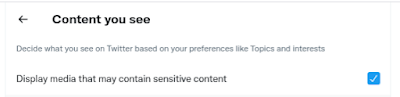
     Example of Twitter to Change View Settings (from above) to Prevent Blocking 


     Example of Twitter Terms to End Accounts for ANY/NO reason effective 6-10-22


Are these new changes letting users control more of what they see or is it still about the social media outlet keeping control of that?  Will users take the 2nd or 3rd click/step required to see the hidden information from selected sites?  Will other platforms choose to change "sensitive" view options that make it sound like users will see pornography instead of platform-deemed "questionable" information.  Are social media owners hoping users will not exercise their personal choice by making the extra effort to click again?  Is the reason platforms are requiring the extra clicks so they can track user choices better or find out what is most popular topics?  Will any of it make a difference to owner's profits, advertiser's bottom-line, or to the user's free speech?  Do social media users still have the option to gather their own facts and form their own opinions? 

Articles and videos continue to get blocked, not because they have been individually "fact checked," but due to the main URL of the .com/.net/.org being targeted for reasons known only to the social media provider.  Or in the case of a video, it might it be a particular YouTube (and competitors), TV, or cable channel suppression.  So where do users go to find truth/facts or lies/fiction now?   

Yes   that's a lot of embedded questions above that are definitely NOT hidden from view!  Why?  Because  questions make you think.  If you think, then you can form your own opinions.  Sharing opinions in an acceptable and respectful way is allowed freedom of speech. The user should have the opportunity to decide, not the social network outlet.  History will tell us if the user's decision is important to the platforms they use.

NOTE:  Twitter changed ownership in 4th quarter 2022, now transparency of past and current processes is ongoing under the new management that is promoting "freedom of speech" but not necessarily freedom of reach?  See December 2022 deletions and solutions articles plus January 2023 infographic, regarding #TwitterFiles compiled data of free speech suppression and hidden truths for political reasons currently being ignored by mainstream media news that proves partisan censorship. 

ADDED NOTE: What about Facebook/Meta Media Mix? FB uses a little italicized i to make it look like users can get more related topic information, but often it tricks people by showing a list of prejudiced articles that express the social media owner's views. Although, upon occasion, it will share if a link site has/hasn't an FB page or other recent videos from that site only if it is "news" site.  But they still limit or outright  block free speech of most vocal conservatives, medical experts, Christians (formerly religious freedom to Bible), and politicians that do not buy into Zuckerberg's obvious malarkey meant only to get FB owner more money - not actually help people. In 2021, Facebook Admits in Court That ‘Fact Checks’ Are Just Opinion - in other words, what the boss wants communicated or NOT.  Then the following year, at Congressional hearing, Facebook CEO blames the government for selected censorship.

Google is no longer in the social media game, but are they a "Big Tech" who is still censoring topics in searches and pushing political ads as actual news? What about those MSN searches, will their AI bots censor even more?

UPDATES: Did DNC government try to crush USA citizens' FREE SPEECH?  Will it ever be fully restored on social media platforms? Will the government and "Big Tech" try to do it again?


Holiday Concerns in Current Business Climate

The holiday season is hectic and often stressful for employees and employers.  Wholesale supply chain issues make it hard to provide what is needed for manufacturing products or selling consumer goods. Piling on the stress for employees is schools choosing to restart on-line learning or reducing the hours on campus during the holiday season.  This forces parents to either take-off from the workplace that they recently returned to or work remotely to cover childcare and insure lessons get done.  It forces employers and their human resource departments to either do without some of their workforce or scramble to create workarounds to continue productive performance.  

New government mandates also add to this stress by telling individual and companies what they have to do and not how to pay for it without increasing the already rising inflation and the cost of doing business. "It pits government against private employers instead of working with them to create a safe working environment” says Retail Industry Leaders Association.  Employee moral and motivation may be at an all-time low with the continued restrictions, changing narrative, and perceived violation of personal rights.

These challenges make it hard for companies to take advantage of the holiday season opportunities to bolster their profits after a particularly hard past tow years.  The economy is on a downward trend making it hard for both employers and employees to look forward to a bright future.  Even though it seems hard to trust that success is around the corner, with the possibility of new "health" lockdowns as occurred in 2020, goal-setting and flexibility are very important to making the next year better for business.  

Short URL for sharing = https://tinyurl.com/2n83wp4a  

Getting Back to Work

The statistics for people returning to work, after the state and/or national shutdowns, can be confusing.  Some reports say possibly 40% of the former workforce DO NOT want to return to work because they are getting paid to stay home by the government in the form of both unemployment benefits and stimulus checks.  Others say that 2/3 of the workforce are afraid to return to work since new cases of virus are being reported and they fear getting sick.  While other reports show 25%-29% want to return to work but want more flexible work days/hours because they got used to telecommuting and doing work-from-home.  

Studies show some employees feel they are more productive working from home, whereas others feel they accomplish more at-the-office.  However, there are articles that show people want to get back to a workplace where they can collaborate in-person with others, not be distracted by children, and also return to developing their careers.

Safety options companies are considering to bring back their employees include:

  • Having everyone in the office, warehouse, restaurant, or store continue to wear face masks provided by company
  • Allowing only people with an approved vaccination and health card to come into company facilities (Rockefeller Foundation survey indicates 9 out of 10 companies prioritize this) 
  • Providing counseling and support and for this stressful situation to those concerned employees
  • Educating employees through health professionals (live or video) on illness signals and stress signs to be aware of
  • Continuing telecommuting and virtual meetings for unvaccinated employees
  • Offering on-and-off site workday scheduling options for experienced employees they wish to keep
  • Using more on-line options for interviewing, hiring, onboarding, and training to fill open positions

Company owners and managers need to decide what IS or is NOT working for the profitability and productivity of their organizations.  After issues are reviewed, re-opening options considered, and best policy/process is chosen to get people back to work, then communicate that to current and potential employees via company website.   Send emails or letters to employees to let them know the highlights and refer them to website for details and new information as decisions are made. 

The Business of Energy - Which is Best for All?

Many parts of America experience cold weather in winter.  However there are also locations in the United States that typically have a mild or warm winter.  In February 2021, most of America woke up to find below freezing weather and that citizens, utility companies, and government agencies were unprepared for the crisis that came next.  Instead of being warm from their heating units, they were cold as power went out when windmills froze and electrical lines went down. Environmental technology was failing!  Not only were people cold, in some places, they were unable to connect via internet or phone - so no working from home or getting televised updates on crisis!  There were others who could not use water for cleaning and drinking as public water facilities went down due to frozen equipment failure and pipes bursting not just in homes, but in many buildings and outside locations. 

For years the USA has been encouraged to move away for the fossil fuels (coal, gas, oil which there is lots of within country across various states) to more environment--friendly "green initiatives" to prevent global warming.  As windmills froze and solar panels proved useless during the gray days and long nights of the cold spell, people began to doubt the wisdom of these initiatives.  When you and your family are huddled under multiple blankets around a small fireplace to keep warm due to power outages, it is hard to believe "global warming" is really a real thing.  Many now believe fossil fuels should still have a key place in America and governments now need to look at the truth about energy alternatives to get the best service and economical options for their citizens. 

Every type of energy resource does have some bad environmental impacts as well as some good ones.  Each type may have: some long-term money saving advantages, immediate economical impact on workers' jobs, and possible expensive start-up costs. Below are links to pros and cons of different energy sources.  Please note that the wind option states that it had less American government money spent on research but it is also primarily a NON-USA business.  Naturally, moving to NON-USA energy sources will automatically mean a reduction of American jobs and ultimately an increase of costs that impacts both citizens and businesses.

Updates in 2023: 

Politics in Marketing Can Kill Business

Have you seen ads mistakenly promoting political agendas as current social issues that they support?  Have you been considering showing similar support for the short run in your marketing?  If you have, then think again before reacting.  This type of political marketing can backfire on a business.  Consider ticket and sponsor losses of the NFL when they appeared to take a political side.

Before you change your website, ads, and social postings, do your research and consider the implications for your business.  Is the political issue or current socialistic opinion being supported by hundreds rather than thousands, by thousands rather than millions?  News reports can often be misleading. Is the group or charity you are considering making a difference?  Is the movement making a difference, is it  peaceful or violent?  Did it physically destroy property, loot other businesses, or hurt people? Is it really a social cause or a political agenda?  However those actions are perceived may reflect on your company as a supporter.   How many customers do you want to get?  How many are you willing to alienate?  How many are you willing to lose?  If you make the wrong move/impression, the company page on social media may blow-up in your face instead of in your sales. Have you researched the issue to be sure it is real and not a lie or hiding a different political agenda?

Instead of using the political issue or socialized opinion "of the week" or month to build an advertising campaign, look for a way to use your marketing budget for the long run to build business.  Create marketing that builds-up you brand instead of promoting the brand of others.  How do you do this?  Sell your value, create brand recognition, and build trust with current and future customers.  Most customers are interested in WIFM (what's in it for me), so sell the value of your product or service.  Build your advertising and social media presence around being known for what you do, and repeat that in multiple formats and places.  This reputation is key to create name recognition and service/product reputation.   Steer away from ads that leave people thinking "That was an interesting commercial.  What was it for?" If you want to build customer loyalty, do it through brand trust.  You have to have trust in your compnay first, an uninformative or misleading advertisement makes people think you are covering something up, therefore killing any chance at building trust.

Still considering putting your political views to grab attention by supporting current issue?  If you are, you may want to read the articles and tips below before you spend your marketing money.
How Social Media Can Kill Your Business
Politics and Marketing
SBDC 8 Steps To Marketing Your Business

Will you let your business be hurt by putting an irresponsible statement in a box promotion or funds into a questionable process/policy? If you move too soon, you may lose business.  If you have already made the wrong move, better backup and hope to reduce/reflect backfire from the larger population not supporting the statements which may be your greatest potential for customers.  It is ok to have a personal political view, however advertising it in your marketing can result in: lost capital now, future loss of consumer business, which means no freedom to innovate and grow your business.  Only a foolish leader makes decisions out of fear or not checking for all the facts. Make sure social media people know to avoid politics and hopefully  avoid boycott and other outcries from customers/readers.

If you have funds you wish to donate anonymously or publicly, make sure they provide a helpful service to society.  Consider ecology and help save the planet.  Or help people by feeding the hungry or housing the homeless.  Before you donate, verify the legitimacy of the charity; as well as their values, goals, and past spending results.  If tax deduction is also important to you, verify what the organization qualifies for since most charitable deductions are not be taken at 100%.  Political contributions are not tax deductible. 

According to the marketing "rule of seven" it takes awhile for people to notice an advertisement.  The more you share information with people, then it may become believable to them even if it is just a cleverly disguised sales pitch.  Be ethical and honest with your potential clients, make sure you statements are truth not lies just for profit.  Dishonesty catches up with a compnay as disillusioned customers will leave in droves and make their dissatisfaction and distrust  known on social media so new customers think twice before buying.

Post Short URL for sharing = https://tinyurl.com/mphb69vw 

NFL Blunders in Business Again and Takes Other Sports With Them!

A few years ago, the NFL Made Business Blunder which lost them and sponsors lots of money because they were seen as unpatriotic.  They eventually took a stand and their fans and customer base began to slowly return.  Due to coronavirus this year, they can not sell tickets, so they are trying to be "relevant"  with a new marketing campaign.  Will this cost them  customers again?  Will the #BoycottNFL cry across social media start again as more people check the historical records of the National Football League on politicizing social issues?  What will it for them to separate their business from player politics?

Other sports leagues or teams (NBA/WNBA, NASCAR, MLB, etc) besides NFL are starting similar campaigns as well.  Some are even considering changing the names of teams.  Are the name and logo changes a politically correct idea or a marketing ploy to pave the way to try to generate income through new sales of re-named sports gear since they cannot sell tickets?  What will their customers/fans think of name changes?  Will they buy into the media hype or continue to abandon professional sports?  Will fans begin to boycott other sports as well as their sponsors and advertisers too?  Will the league owners lose money when sponsorship goes away?  Will the players now lose their bloated million dollar salaries?  Will professional sports eventually go from being big business back to a low cost athletic-based pastime fro fans?  Or will USA sports decide their business would be safer if they go back to separating themselves from political agendas as UK sports do?  Forbes suggests Case To Separate Sports And Politics For More Fans And Higher Ratings.

Headlines below show a few of the results from political activism in American sports.
2024 NEWS:  NFL obviously thinks their fans have a short memory.  In 2024, NFL teams decide the national anthem "The Star Spangled Banner" is not good enough for them.  They decide to play alternative tunes before it or instead of it.  #BoycottNFL has started to tend again.  When will AMerican citizens drop high-pay football and only watch school sports or drop football al together and just keep the national pastime as Baseball...

Where Are Women's Rights in the Workforce?

The Civil Rights Act of 1964 specifically required equal treatment of individuals regardless of gender. This meant qualified women should be considered for hiring and promotion if they match the job requirements as well as a man.  The oldest and most accepted definition and/or synonym for the word sex is gender.

Recently, the "educated" members of the Supreme Court and Congress decided to redefine the word sex from the previously accepted gender to indicate terms of private intimacy preferences. In essence destroying the gender equality portion of the Civil Rights Act and replacing it with behavior-based concepts. What does this mean for the working woman now? 
  • Since gender is not an issue, does it mean wages and job options will recede to pre-1963 when equal pay for equal work was enacted?
  • Since sexual orientation is now the issue, does it mean that sexual harassment may increase over what it was in the 1980's and become even more prevalent in the future?
  • Since gender equality is not important, will women lose their jobs and  be forced to return to pre-WWII stay-at-home status?
  • Since gender is gone as an issue, what is next to lose -  women's right to vote which was gained back in 1920?
What has happened to business leaders saying workforce diversity is important for idea generation and problem solving?  Where are all the so-called feminists hiding that allowed this to happen? Is everyone so focused on face masks and other protest actions that what has already been gained is allowed to slowly die away? 

Obviously there are not enough women on the Supreme Court or in Congress to protect female rights. Will women's right continue to go backwards as Twitter video clams?   Perhaps it is not about gender, maybe it is an attempt to increase lawsuits against businesses?  Maybe the reasoning is business and personal values are not as important to economy as a backlogged legal system is...

Pray fro women's rights, not only in USA, but everywhere around the world.  Taliban rule will be 'a long slow death' for women,

POST SHORT URL = https://tinyurl.com/2d46c8bm  

Ways Businesses Protect Employees and Inform Others During Global Isolation

Very few businesses today are not global in some way.  It is easy to think of large corporations as global because they may have offices in more than one country.  However, any company that has an on-line business is most likely global as they may be sending products or services anywhere in the world.  Even if a small business does not go outside their home country for customers, they may be getting materials from a supplier based in another country.  Face it, current times meant a global economy.  Anything that happens outside your country can possibly impact your business.

INC magazine says Coronavirus May Already Be Affecting Your Business.

What can you do to help your employees at this time?  If they must be at work because your business is one that supports citizens in time of crisis, then provide the materials to protect your employees and customers.  During a pandemic/epidemic or natural disaster, for most this would be hand sanitizer, gloves, soap, water, googles, face masks, and a way to communicate with superiors and where necessary other agencies. For a specialized workforce, there may be additional requirements to meet industry standards.  It is important to provide a safe workplace or outside work environment for your employees.  Knowing you are providing this for them will keep them going and will give some comfort to your concerned customers as well.

If your business is important but is not a support organization, then provide ways for employees to work-at-home (such as telecommuting or virtual meetings), take on-line training/education courses and attend webinars, or take time-off (such as sick leave, LOA, vacation, or furlough) without losing their jobs.  Although your business is important to you, it may not be key during national or global times of crisis.   If this is the case, you may want to consider letting people take time off and if necessary closing for a short period of time.

Forbes magazine shared Impact Of The Coronavirus On Business and the economy, as well as statistics and  plans for What Businesses Can Do In Response To The Coronavirus.

This is why many organizations are taking the time to communicate with their employees, suppliers, and customers what they are doing during local or global difficulties.  Although a few may complainthey are getting to many emails, most will be comforted by the shared information,  Also a few businesses  are going beyond email and taking the time to use social media or upload videos about what they are doing or how they are supporting efforts to keep both out-of-work employees and customers informed.

The new business slogan to customers and employees becomes "let us take care of you while you take care of yourself."

Social Media is Changing Public Administration Infographic

​‌Social media has had significant impacts on government​al entities, ​forcing them to respond, 
​refine  and ​reconsider  governance in a digital age. Effective social media usage ​is much more than an ROI ​and​ increasingly important for citizen engagement,​ crime prevention,​ crisis management and even national security.  The below inforgraphic by Rutgers O​nline Master of Public Administration Program explores the impact social media engagement has had on governmental departments and tips for agencies to better excel with social media.

Crisis Management: Stop Putting Out Fires

I frequently hear “I try to plan my day but instead I end up moving from crisis to crisis putting out fires.”  These folks are frustrated and exhausted from the effort of “fixing” things when they go wrong and not having time to accomplish the items on their to-do lists.

Quite often when asked to describe the crisis we can trace it back to the point of possibily preventing it from ever happening.  Here are a few simple examples:
  • Running out of gas – When do you fill the gas tank?  When the gauge says E and you have to search for a gas station when you are late?  Or when it shows a half or quarter?
  • Power goes out – Do you have an emergency kit with a flashlight located in key rooms?
  • Missing a flight – When did you pack?  That day or several days before?  Did you use a list so nothing was forgotten?  When did you leave for the airport? 
  • A key contributor leaves – Do you have a formal succession plan in place to easily fill vacancies or do you now have to undergo a long search leaving this key position vacant?
As you can see planning and avoiding procrastination are keys in helping to prevent crises. Crisis management is constantly considering Murphy ’s Law “Anything that can go wrong will go wrong."  By planning for all the things that can go wrong, when we get a visit from Mr. Murphy we are prepared.  Some people never plan for a crisis considering it a waste of time because they might be planning for something that never happens.  The key is to consider the large amount of time, energy and money spent if it does go wrong and the impact on your health, stress level and maybe even your career. 
We cannot prevent every crisis but we can be prepared if a crisis occurs. Every organization should consider implementing an Emergency Response Plan which considers all possible natural and human disaster that may impact their specific industry and geographic area.  The Federal Emergency Management Agency (FEMA) provides sample plans. 
We can use these same concepts in our personal life considering what we might face in such areas as our finances by saving for our children’s college and our retirement; maintaining and monitoring our health for disease prevention; considering the area of the country where we live and prepare for the natural disasters might occur.
Consider this quote from President John F. Kennedy: “When written in Chinese, the word "crisis" is composed of two characters. One represents danger and the other represents opportunity.”   Why not take the opportunity today to prevent and prepare for the dangers that might impact your business and family?

Is Not Having A Crisis Management Plan Risky For Business?

Video below talks about the risk you take with income and expenses, if you do not have a good crisis plan.  In the just over 4 minutes, Alan Stratton explains why a good crisis management plan includes some accounting analysis done right away.

If you want to know the risk to your company reputation, which may be harder to figure in dollars, check out these 2 videos as well.  Diane Stein of Joto Extreme PR on why crisis management is important for maintaining a good corporate reputation at http://youtu.be/DdKGvk7e2PQ.  Karla Jo Helms, of same PR organization, shares how good press done regularly can help to prevent negative press as part of Crisis Management Strategy in http://youtu.be/qaOShocGDQo video.

If you are convinced to start a crisis management plan, you may also want to review prior posts on communication plan video and crisis management book.

Start Planning to Improve Crisis Management

It is a shame that most MBA programs only offer one course or a short lecture series on Crisis Management.  Surely they are aware of what has happened to so many companies over the last few years just because they did not plan properly.  Are business schools not aware of the research that shows for each $1 invested in crisis management, an organization can avoid a loss of $7?

Do you have an MBA?  Did it prepare you for a major business crisis?  Does your company even have a crisis management plan?  Are you personally trained to help create one or to implement it?  If not, then as an introduction to the concept, you may want to read the new book Manager’s Guide to Crisis Management (on Amazon #ad) by Jonathan Bernstein.  His book covers various aspects of crisis management including prevention, planning, training, press, communication, law, and potential cultural issues for global companies.  Below is a sample of a few tips from chapter 3 regarding crisis planning. 

Essential Components for a Crisis Plan
1.      Make it easy to reference by including both a table of contents and index.
2.      Introduce the plan with purpose statement, goals, scope, and policies.
3.      Keep documentation (minutes, actions, changes, press releases) related to the plan together.
4.      Locate Emergency Operations Center(s) and note location details.
5.      Select Team members, assign roles and responsibilities, document who does what.
  • Core team should be senior executives and select management
  • Supplemental teams may be required  if company has multiple locations
  • Alternative members should be selected in case a member of other teams is unavailable at time of crisis
  • Contact list with communication methods (email, phones, etc.)
6.      Document possible crisis scenarios, procedures to follow for each scenario and possible communications including press statements.
7.      Identify and train spokespersons from teams to speak during crisis
8.      Establish communication protocols and methods for using contact list during crisis.
9.      Plan communication for all stakeholders and audiences that may be affected by the crisis. 
10. Plan to include a “lessons learned” summary of what was done during a crisis to identify strengths and weakness for future improvements. 

Ten Golden Rules Of Crisis Communication

Below is a short 2.5 minute video from a Crisis Communication Conference that was uploaded in 2009.  To find out more about future conferences in Europe, visit http://www.crisis-communication.net/.  To find out more about crisis management, check next post for a helpful book.

Here is a summary of the 10 golden rules that are presented in the video. 
  1. Acknowledge mistakes
  2. Take quick action
  3. Have a long-term strategy
  4. Communicate from management to all levels
  5. Be a reliable source for the media at a comfortable distance
  6. Restrain the desire to win the argument
  7. If appropriate and honest, dare to overreact
  8. Do not try to create consensus
  9. Consider all key audience in communications
  10. Never stop monitoring problems and issues